
Introduction
In today's digital world, documents, transactions, and communications are increasingly exchanged online. As businesses and individuals rely more on digital platforms, it becomes essential to verify the authenticity of information and ensure that it has not been modified. This is where Digital Signatures play a crucial role.
Digital Signatures are one of the most important applications of cryptography. They provide authentication, integrity, and non-repudiation, making digital communication secure and trustworthy.
1. What are Digital Signatures?
Definition:
A Digital Signature is a cryptographic technique used to verify the authenticity, integrity, and origin of a digital message, document, or transaction.
Explanation:
A Digital Signature acts like a handwritten signature in the digital world, but it is far more secure. It uses mathematical algorithms and cryptographic keys to prove that a message was sent by a specific person and has not been altered after signing.
Unlike traditional signatures that can be forged, digital signatures are based on cryptographic principles, making them extremely difficult to counterfeit.
Example:
When a company digitally signs a software update, users can verify that the software genuinely came from the company and has not been modified by attackers.
2. Importance of Digital Signatures
2.1 Verification of Identity
Definition:
Digital Signatures verify the identity of the sender.
Explanation:
They ensure that the message or document was created by the claimed sender. This prevents attackers from impersonating legitimate users.
Example:
A bank can verify that a transaction request actually came from the account holder.
2.2 Ensuring Data Integrity
Definition:
Digital Signatures confirm that the data has not been modified.
Explanation:
Even a single-character change in a digitally signed document invalidates the signature. This helps detect tampering immediately.
Example:
A signed contract cannot be altered without detection.
2.3 Non-Repudiation
Definition:
Prevents the sender from denying their actions.
Explanation:
Since only the sender possesses the private key used for signing, they cannot later deny sending the message.
Example:
A digitally signed financial transaction serves as legal proof of authorization.
2.4 Building Trust
Definition:
Creates confidence in digital communications.
Explanation:
Users trust digital systems more when they can verify the authenticity and integrity of information.
Example:
Secure government portals use digital signatures to authenticate official documents.
3. Components of a Digital Signature System
3.1 Public Key
Definition:
A publicly available key used to verify digital signatures.
Explanation:
Anyone can access the public key. It does not reveal the private key and is used only for verification purposes.
Example:
Websites distribute public keys through digital certificates.
3.2 Private Key
Definition:
A secret key used to create digital signatures.
Explanation:
The private key must remain confidential. Anyone who gains access to it can create fake signatures.
Example:
A company securely stores its private key on protected servers.
3.3 Hash Function
Definition:
A mathematical function that converts data into a fixed-length hash value.
Explanation:
Digital signatures do not sign the entire document directly. Instead, they sign the document’s hash value, making the process faster and more efficient.
Example:
A 100-page document may generate a short hash value that is digitally signed.
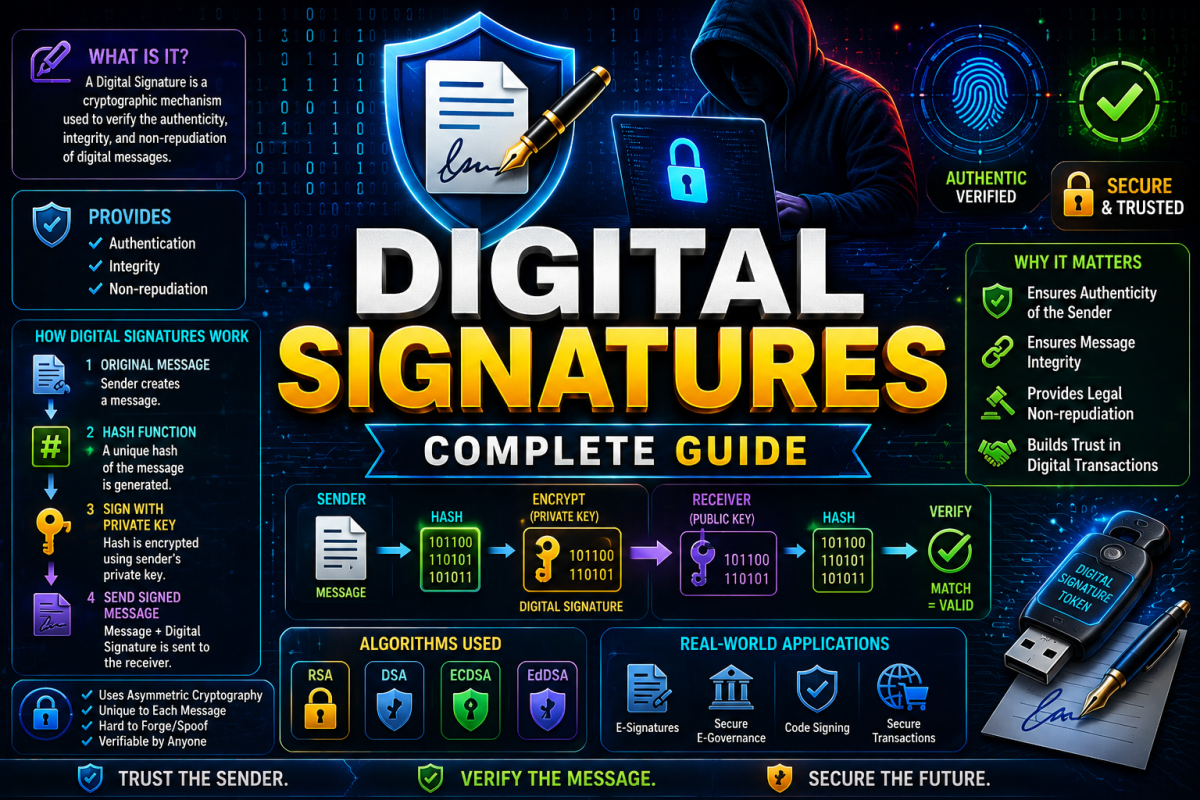
4. How Digital Signatures Work
Step-by-Step Process:
Step 1: Create the Message
The sender prepares the original message or document.
Step 2: Generate a Hash
A cryptographic hash function creates a unique fingerprint of the message.
Step 3: Sign the Hash
The sender encrypts the hash using their private key.
Step 4: Attach Signature
The encrypted hash is attached to the message as the digital signature.
Step 5: Verification
The receiver decrypts the signature using the sender’s public key and compares it with a newly generated hash.
Step 6: Validation
If both hash values match, the signature is valid and the message is authentic.
5. Characteristics of Digital Signatures
5.1 Authentication
Definition:
Confirms the identity of the sender.
Explanation:
Only the owner of the private key can generate a valid signature, making sender verification possible.
5.2 Integrity
Definition:
Ensures data has not been modified.
Explanation:
Any change to the document changes its hash value, causing signature verification to fail.
5.3 Non-Repudiation
Definition:
Prevents denial of signed actions.
Explanation:
The sender cannot later claim that they did not sign the document.
5.4 Security
Definition:
Provides strong protection against forgery.
Explanation:
Modern digital signature algorithms use complex mathematical operations that are extremely difficult to break.
6. Types of Digital Signatures
6.1 Simple Digital Signature
Definition:
Basic electronic signing method.
Explanation:
Used for low-risk transactions and basic authentication.
Example:
Signing internal company documents.
6.2 Advanced Digital Signature
Definition:
Provides stronger security and verification.
Explanation:
It uniquely identifies the signer and detects document modifications.
Example:
Business agreements and legal contracts.
6.3 Qualified Digital Signature
Definition:
The highest level of digital signature security.
Explanation:
Issued by certified authorities and legally recognized in many countries.
Example:
Government records and official legal documents.
7. Popular Digital Signature Algorithms
RSA Digital Signature
Definition:
One of the most widely used digital signature algorithms.
Explanation:
Uses public and private key cryptography to create and verify signatures securely.
DSA (Digital Signature Algorithm)
Definition:
A digital signature standard developed by security agencies.
Explanation:
Designed specifically for digital signatures rather than encryption.
ECDSA (Elliptic Curve Digital Signature Algorithm)
Definition:
An advanced signature algorithm based on elliptic curve cryptography.
Explanation:
Provides strong security with smaller key sizes and faster performance.
8. Applications of Digital Signatures
Secure Email Communication
Digital signatures verify the sender and protect email integrity.
Online Banking
Banks use digital signatures to secure transactions and customer communications.
Software Distribution
Software companies sign applications to prove authenticity.
Legal Documents
Contracts and agreements can be signed electronically with legal validity.
E-Governance
Governments use digital signatures for certificates, licenses, and official records.
9. Advantages of Digital Signatures
Verifies sender identity
Ensures data integrity
Prevents forgery and impersonation
Supports legally valid electronic transactions
Reduces paperwork and administrative costs
Increases trust in digital systems
10. Limitations of Digital Signatures
Private key protection is critical
Initial setup can be complex
Requires certificate management infrastructure
Compromised private keys can create security risks
Conclusion
Digital Signatures are a fundamental component of modern cybersecurity. They provide authentication, integrity, and non-repudiation, making digital communication secure and reliable.
As organizations increasingly move toward digital operations, understanding Digital Signatures becomes essential for students, IT professionals, and cybersecurity experts. They not only protect information but also establish trust in online interactions.
Want to master Cryptography, Cybersecurity, and Ethical Hacking?
👉 Join BNIT Computer Education
👉 Learn from beginner to advanced level
👉 Practical training with real-world security concepts
👉 Industry-focused IT and cybersecurity courses
Start your journey today and become a skilled cybersecurity professional.
BNIT Computer Education – Building Future Technology Experts