
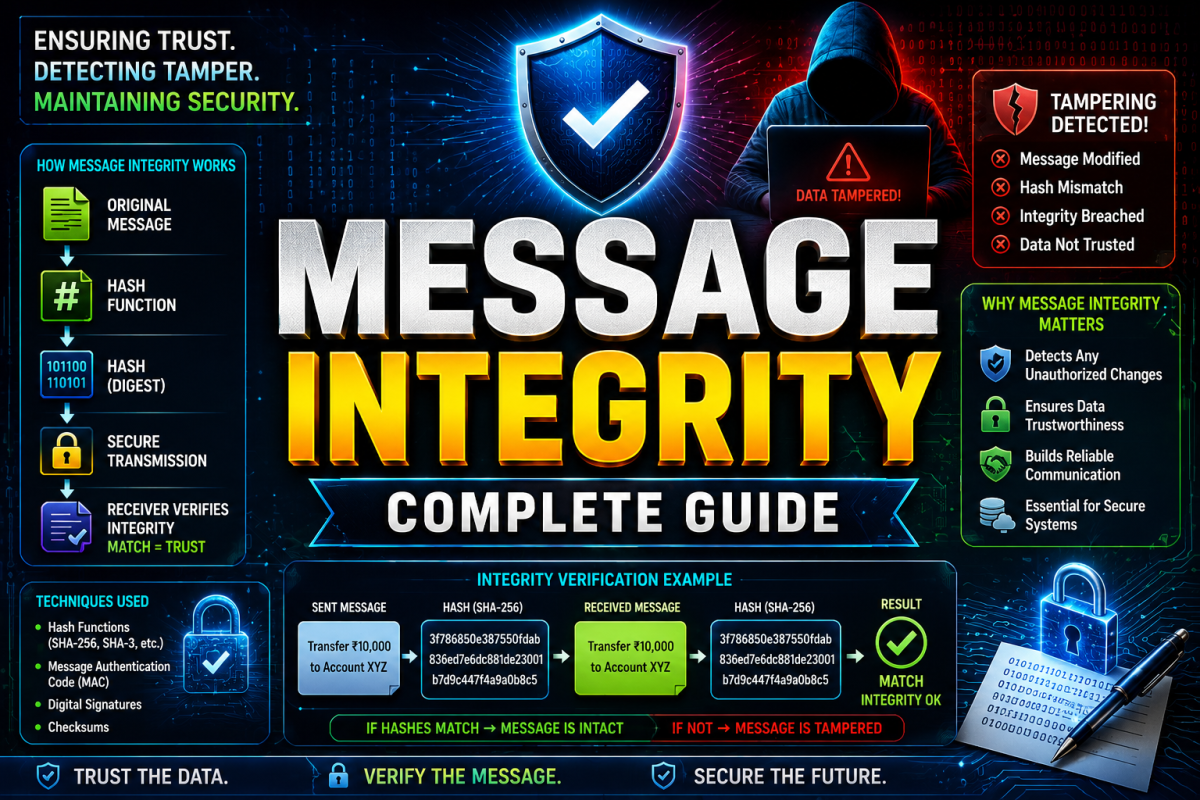
In modern digital communication, data constantly travels through networks, servers, and devices. During transmission, there is always a risk that the message may be modified intentionally by attackers or accidentally due to technical issues. This is where Message Integrity becomes extremely important.
1. What is Message Integrity?
Definition:
Message Integrity is the process of ensuring that a message or data has not been altered, modified, or tampered with during transmission or storage.
Explanation:
When a sender transmits data over a network, attackers may try to change the information. Message Integrity mechanisms detect these changes immediately. It guarantees that the information received is authentic and unchanged.
Message Integrity does not necessarily hide the data like encryption; instead, it ensures that the content remains accurate and trustworthy.
Example:
If a bank transaction message says:
“Transfer 1000 INR”
and an attacker changes it to:
“Transfer 9000 INR”
Integrity mechanisms will detect the modification.
2. Importance of Message Integrity
2.1 Protection Against Data Tampering
Definition:
Ensures that unauthorized users cannot modify data without detection.
Explanation:
Hackers may attempt to alter sensitive information such as financial transactions, passwords, or confidential documents. Integrity mechanisms help identify such changes immediately.
Example:
Changing marks in a student database without authorization.
2.2 Building Trust in Communication
Definition:
Ensures that communication remains reliable and trustworthy.
Explanation:
Users and organizations depend on accurate data. If messages can be modified unnoticed, digital systems become unreliable.
Example:
Secure email systems that verify message authenticity.
2.3 Preventing Fraud and Cybercrime
Definition:
Integrity mechanisms help prevent manipulation-based attacks.
Explanation:
Financial fraud often involves modifying transaction details. Message Integrity helps detect such malicious activities.
Example:
Tampering with online payment information.
3. How Message Integrity Works
Step-by-Step Process:
Sender prepares the original message
A hash value or integrity code is generated
Message and integrity value are sent together
Receiver generates a new hash from received data
Both hash values are compared
If values match → message is unchanged
If values differ → message was modified
Explanation:
This process allows systems to detect even the smallest changes in data.
4. Methods Used to Achieve Message Integrity
4.1 Hash Functions
Definition:
A hash function converts data into a fixed-length value called a hash.
Explanation:
Hash functions generate a unique fingerprint for data. Even a tiny change in the message creates a completely different hash value.
Example:
Input: “HELLO”
Hash: “A7X92L”
Input: “Hello”
Hash: “P9Q4ZT”
The outputs are entirely different.
4.2 Message Authentication Code (MAC)
Definition:
A MAC is a cryptographic code used to verify message integrity and authenticity.
Explanation:
It combines a secret key with the message to generate a unique value. Only authorized users with the correct key can validate the message.
Example:
Used in secure communication systems and APIs.
4.3 Digital Signatures
Definition:
A digital signature verifies message integrity and sender authenticity.
Explanation:
The sender signs the message using a private key, and the receiver verifies it using the public key. If the message changes, the signature verification fails.
Example:
Digital contracts and secure software downloads.
5. Characteristics of Message Integrity
5.1 Tamper Detection
Definition:
Ability to detect unauthorized changes.
Explanation:
Even changing one character in the message changes the integrity value, allowing systems to detect tampering instantly.
5.2 Data Consistency
Definition:
Ensures that data remains accurate and unchanged.
Explanation:
This is critical for databases, banking systems, and cloud storage where accuracy is essential.
5.3 Reliability
Definition:
Provides confidence in communication systems.
Explanation:
Users trust systems more when they know messages cannot be modified secretly.
5.4 Security Enhancement
Definition:
Improves overall cybersecurity protection.
Explanation:
Integrity mechanisms work alongside encryption and authentication to create secure systems.
6. Difference Between Integrity and Confidentiality
| Feature | Integrity | Confidentiality |
|---|---|---|
| Purpose | Prevent modification | Prevent unauthorized access |
| Focus | Data accuracy | Data secrecy |
| Techniques | Hashing, MAC, signatures | Encryption |
| Example | Detecting changed message | Hiding message content |
7. Real-World Applications of Message Integrity
Banking Systems
Integrity checks ensure that transaction details are not altered during processing.
Secure Messaging Apps
Applications verify that messages arrive unchanged.
Software Downloads
Digital signatures ensure downloaded files are authentic and not infected with malware.
Cloud Storage
Integrity verification ensures stored files are not corrupted or modified.
Blockchain Technology
Hashing ensures that blockchain records cannot be changed without detection.
8. Threats to Message Integrity
8.1 Man-in-the-Middle Attack
Definition:
An attacker intercepts and modifies communication between two users.
Explanation:
Without integrity protection, users may never realize the message was altered.
8.2 Replay Attack
Definition:
Reusing previously captured valid messages.
Explanation:
Attackers resend old messages to trick systems.
8.3 Data Corruption
Definition:
Accidental modification of data due to hardware or transmission errors.
Explanation:
Integrity checks help detect accidental corruption as well.
9. Advantages of Message Integrity
Detects unauthorized modifications
Builds trust in digital communication
Prevents fraud and cyber attacks
Ensures data accuracy and reliability
Essential for secure systems
10. Limitations of Message Integrity
Does not hide data content
Requires additional computational resources
Weak algorithms can reduce security
Needs proper implementation for effectiveness
Conclusion
Message Integrity is one of the most important principles in cybersecurity. It ensures that information remains accurate, trustworthy, and unchanged during communication or storage.
Without integrity protection, digital systems would become vulnerable to fraud, manipulation, and cyber attacks. Modern technologies like hashing, MACs, and digital signatures make secure communication possible.
Understanding Message Integrity helps students build strong knowledge in cryptography and cybersecurity fundamentals.